Caffeine
Also known as 1,3,7-trimethylxanthine, coffee extract, tea extract
Key takeaways
- Caffeine improves endurance running performance and time to exhaustion (PMID: 36615805).
- The combination of L-theanine and caffeine improves cognitive performance and subjective alertness (PMID: 21040626).
- Caffeine intake has a positive dose-response effect on weight loss (PMID: 30335479).
What the research shows
AI-synthesized from 82 peer-reviewed sources · Updated 2025
Caffeine is a widely used methylxanthine stimulant that primarily acts as an adenosine antagonist. Research consistently demonstrates its efficacy in enhancing athletic performance, cognitive alertness, and metabolic rate, though individual responses vary based on genetics.
By condition
Athletic Performance
Strong
Caffeine significantly improves endurance running performance, time to exhaustion, and overall exercise performance across various sports.
Cognitive Function
Moderate
Caffeine enhances alertness and cognitive performance, particularly when combined with L-theanine to improve focus and mood.
Weight Loss
Moderate
Caffeine intake is associated with increased fat oxidation and weight loss in a dose-response manner.
Shift Work Sleepiness
Moderate
Caffeine is used as a pharmacological intervention to manage sleepiness and disturbances caused by shift work.
Effective doses
Specific doses vary; one RCT utilized 50mg of caffeine (often combined with 100mg L-theanine) for cognitive effects (PMID: 18681988), while other studies focus on dose-response relationships for weight loss and endurance.
Safety & interactions
Caffeine can cause sleep disturbances and may interact with certain genotypes; caution is advised regarding dosage to avoid overstimulation.
Limitations
There is significant inter-individual variability due to genetic susceptibility (CYP1A2), and some meta-analyses are limited by small sample sizes in specific sports contexts.
Top-rated Caffeine products
Ranked by safety score and evidence coverage
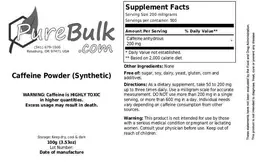
Drug–supplement interactions
37 documented interactions
| Drug | Severity | Mechanism | Evidence |
|---|---|---|---|
| Cocaine (nasal) | Critical | Interaction identified from DDInter 2.0 database. Specific drugs: Cocaine (nasal | ddinter-verified |
| Cocaine (topical) | Critical | Interaction identified from DDInter 2.0 database. Specific drugs: Cocaine (topic | ddinter-verified |
| Esketamine | Critical | Interaction identified from DDInter 2.0 database. Specific drugs: Esketamine | ddinter-verified |
| Tizanidine | Critical | Interaction identified from DDInter 2.0 database. Specific drugs: Tizanidine | ddinter-verified |
| Abametapir (topical) | Moderate | Interaction identified from DDInter 2.0 database. Specific drugs: Abametapir (to | ddinter-verified |
| Adenosine | Moderate | Interaction identified from DDInter 2.0 database. Specific drugs: Adenosine | ddinter-verified |
| Antibiotics | Moderate | Interaction identified from DDInter 2.0 database. Specific drugs: Thiabendazole, | ddinter-verified |
| Antiplatelet Drugs | Moderate | Interaction identified from DDInter 2.0 database. Specific drugs: Acetylsalicyli | ddinter-verified |
| Capmatinib | Moderate | Interaction identified from DDInter 2.0 database. Specific drugs: Capmatinib | ddinter-verified |
| Chemotherapy | Moderate | Interaction identified from DDInter 2.0 database. Specific drugs: Bendamustine, | ddinter-verified |
How it's sold
Data aggregated from 358 product labels
Research evidence
Showing top 10 of 82 sources, sorted by quality
**Boedt et al., 2021** | Cochrane Database Syst Rev | Meta Analysis Boedt Tessy, Vanhove Anne-Catherine, ... Lie Fong Sharon. Preconception lifestyle advice for people with infertility. Cochrane Database Syst Rev. 2021-Apr-29;4(4):CD008189.…
**Tabrizi et al., 2019** | Crit Rev Food Sci Nutr | Meta Analysis Tabrizi Reza, Saneei Parvane, ... Asemi Zatollah. The effects of caffeine intake on weight loss: a systematic review and dos-response meta-analysis of randomized controlled t…
**Barreto et al., 2023** | Eur J Sport Sci | Meta Analysis Barreto G, Loureiro L M R, ... Saunders B. Effects of caffeine chewing gum supplementation on exercise performance: A systematic review and meta-analysis. Eur J Sport Sci. 2023-May;…
**Low et al., 2024** | J Transl Med | Systematic Review Low Jazreel Ju-Li, Tan Brendan Jen-Wei, ... Tan Eng-King. Genetic susceptibility to caffeine intake and metabolism: a systematic review. J Transl Med. 2024-Oct-22;22(1):961. doi:10.118…
**Liira et al., 2014** | Cochrane Database Syst Rev | Meta Analysis Liira Juha, Verbeek Jos H, ... Ruotsalainen Jani H. Pharmacological interventions for sleepiness and sleep disturbances caused by shift work. Cochrane Database Syst Rev. 20…
**Wang et al., 2022** | Nutrients | Meta Analysis Wang Ziyu, Qiu Bopeng, ... Del Coso Juan. Effects of Caffeine Intake on Endurance Running Performance and Time to Exhaustion: A Systematic Review and Meta-Analysis. Nutrients. 2022-Dec-28;15…
**Asbaghi et al., 2024** | Br J Nutr | Meta Analysis Asbaghi Omid, Rezaei Kelishadi Mahnaz, ... Zamani Mohammad. The effects of green tea extract supplementation on body composition, obesity-related hormones and oxidative stress markers: a …
**Phung et al., 2010** | Am J Clin Nutr | Systematic Review Phung Olivia J, Baker William L, ... Coleman Craig I. Effect of green tea catechins with or without caffeine on anthropometric measures: a systematic review and meta-analysis. Am J…
**Guest et al., 2018** | Med Sci Sports Exerc | Rct Guest Nanci, Corey Paul, ... El-Sohemy Ahmed. Caffeine, CYP1A2 Genotype, and Endurance Performance in Athletes. Med Sci Sports Exerc. 2018-Aug;50(8):1570-1578. doi:10.1249/MSS.000000000000…
The non-proteinic amino acid L-theanine and caffeine, a methylxanthine derivative, are naturally occurring ingredients in tea. The present study investigated the effect of a combination of 97 mg L-theanine and 40 mg caffeine as compared to …
Frequently asked questions
What is caffeine and how does it work?
Caffeine is a widely used methylxanthine stimulant that acts primarily as an adenosine antagonist. Research consistently demonstrates its efficacy in enhancing athletic performance, cognitive alertness, and metabolic rate, though individual responses vary based on genetics.
Does caffeine improve athletic performance?
Yes, there is strong evidence that caffeine significantly improves endurance running performance, time to exhaustion, and overall exercise performance across various sports. However, genetic variations in the CYP1A2 genotype can influence how effectively an individual responds to caffeine for endurance.
Can caffeine help with weight loss?
There is moderate evidence that caffeine intake is associated with increased fat oxidation and weight loss in a dose-response manner. While it can support weight management, it is not a standalone solution and should be used with caution to avoid overstimulation.
Does caffeine improve focus and cognitive function?
There is moderate evidence that caffeine enhances alertness and cognitive performance, particularly when combined with L-theanine to improve focus and mood. Specific studies have utilized doses such as 50mg of caffeine combined with 100mg of L-theanine for these cognitive effects.
What are the common side effects of caffeine?
Caffeine can cause sleep disturbances and may lead to overstimulation if dosages are too high. Individuals should be cautious with dosage, as excessive intake can negatively impact sleep quality and overall well-being.
Who should avoid caffeine or use it with caution?
People taking lithium should avoid caffeine because it increases renal lithium clearance, and abrupt cessation can increase lithium levels. Additionally, those on antidiabetic drugs should be cautious as caffeine may impair insulin sensitivity and raise blood glucose acutely.
Does caffeine interact with antibiotics or other medications?
Yes, certain quinolone antibiotics like ciprofloxacin can inhibit the metabolism of caffeine, leading to increased levels in the body. It is also well-established that combining caffeine with theophylline has additive stimulant effects, so consulting a healthcare provider is recommended.