Home/ Supplements/ Paba/ Take Heart II Without Hormones

Take Heart II Without Hormones

product on market Powder Allergy Research Group Safety: 100/100
100/100

This product looks safe

  • Niacin: 160mg is 4.6× the Tolerable Upper Intake Level (35mg)
  • 40% of ingredients have research evidence
C Label Compliance Grade

What the Evidence Says

AI-generated · Qwen 3.6 · methodology

The listed top ingredients consist of basic macronutrients and cholesterol, which provide general caloric energy rather than targeted therapeutic effects. There is limited clinical evidence linking these specific nutritional components to targeted health outcomes in a supplement context. The product maintains a high safety profile based on available data.

AI-generated summary based on research evidence. Not medical advice.

Alerts

Safety Alerts

Niacin: 160mg is 4.6× the Tolerable Upper Intake Level (35mg)

Label

Product Label

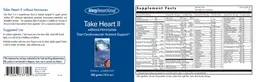
Label for Take Heart II Without Hormones
Open Full PDF View on NIH DSLD →
Details

Label Data

20 Gram(s)
Serving Size
15
Servings
Other Combinations
Product Type
40%
Evidence Coverage
Ingredients

Supplement Facts — Evidence Check

Calories
50 {Calories}
Calories from Fat
30 {Calories}
Total Fat
3 Gram(s) (5% DV)
Cholesterol
8 mg (3% DV)
Total Carbohydrates
4 Gram(s) (1% DV)
Protein
1 Gram(s) (2% DV)
Vitamin A
2000 IU (40% DV)
Vitamin C
500 mg (830% DV)
100 IU (25% DV)
Within RDA (0.2× RDA) 608 studies (A:16, B:251)
320 IU (1070% DV)
14.3× RDA — above typical dose (UL: 1000 mg) 179 studies (A:3, B:90)
80 mcg (100% DV)
Within RDA (0.7× RDA) 275 studies (A:9, B:175)
30 mg (2000% DV)
25.0× RDA — above typical dose 76 studies (A:0, B:33)
30 mg (1765% DV)
23.1× RDA — above typical dose 13 studies (A:0, B:1)
160 mg (800% DV)
Exceeds UL by 4.6× (UL: 35 mg) 196 studies (A:5, B:63)
16 mg (800% DV)
12.3× RDA — above typical dose (UL: 100 mg) 114 studies (A:3, B:35)
320 mcg (80% DV)
Within RDA (0.8× RDA) 226 studies (A:10, B:105)
80 mcg (1330% DV)
33.3× RDA — above typical dose 139 studies (A:1, B:44)
240 mcg (80% DV)
8.0× RDA — above typical dose 27 studies (A:0, B:11)
100 mg (1000% DV)
20.0× RDA — above typical dose 2 studies — no high-quality reviews
Calcium
280 mg (28% DV)
160 mg (40% DV)
Within RDA (0.4× RDA) 316 studies (A:8, B:159)
12 mg (80% DV)
1.1× RDA — within safe limits 263 studies (A:6, B:134)
80 mcg (115% DV)
1.5× RDA — within safe limits 173 studies (A:0, B:67)
800 mcg (40% DV)
Within RDA (0.9× RDA) 37 studies (A:0, B:11)
1 mg (50% DV)
Within RDA (0.4× RDA) 9 studies — no high-quality reviews
160 mcg (130% DV)
4.6× RDA — above typical dose 199 studies (A:1, B:55)
40 mcg (53% DV)
Within RDA (0.9× RDA) 3 studies — no high-quality reviews
Potassium
40 mg (1% DV)
0.4 mg
Market median: 3.0mg (58 products) 3 studies — no high-quality reviews
80 mcg
Market median: 0.5mg (6 products) 1 studies (A:0, B:1)
Alpha-Carotene
8 mg
60 mg
Market median: 100.0mg (283 products) 144 studies (A:1, B:64)
50 mg
Market median: 550.0mg (217 products) 29 studies (A:0, B:5)
50 mg
Within RDA (0.1× RDA) 38 studies (A:1, B:7)
Market median: 500.0mg (9 products) 7 studies — no high-quality reviews
500 mg
Market median: 60.0mg (94 products) 13 studies (A:0, B:7)
L-Alanine
30 mg
480 mg
Market median: 500.0mg (143 products)
Market median: 2000.0mg (63 products)
200 mg
Market median: 500.0mg (861 products) 61 studies (A:4, B:13)
Alpha-Glucan Oligosaccharide
10 mg
600 mg
Market median: 420.0mg (227 products)
Glycine
30 mg
L-Histidine
20 mg
35 mg
Market median: 17.4mg (161 products)
60 mg
Market median: 17.4mg (161 products)
45 mg
Market median: 500.0mg (159 products)
160 mg
Market median: 500.0mg (193 products) 7 studies — no high-quality reviews
L-Ornithine
200 mg
L-Phenylalanine
38 mg
L-Proline
38 mg
L-Serine
38 mg
500 mg
Market median: 500.0mg (180 products) 5 studies (A:0, B:1)
L-Threonine
28 mg
220 mg
Market median: 500.0mg (223 products) 24 studies (A:0, B:1)
L-Valine
40 mg
N-Acetyl-L-Cysteine
200 mg
Glutathione
100 mg
Pancreatin
10 mg
Papain
16 mg
20 mg
Market median: 200.0mg (136 products) 3 studies — no high-quality reviews
Grape skin extract
200 mg
Market median: 333.0mg (166 products) 9 studies (A:0, B:2)
100 mg
Market median: 500.0mg (497 products) 135 studies (A:0, B:40)
2 mg
Market median: 10.0mg (105 products) 2 studies (A:0, B:1)
400 mcg
Market median: 10.0mg (35 products) 6 studies (A:0, B:2)
20 mg
1.3× RDA — within safe limits 179 studies (A:3, B:90)
Market median: 496.0mg (192 products) 20 studies — no high-quality reviews
Market median: 1000.0mg (2 products)
Market median: 750.0mg (447 products) 393 studies (A:18, B:204)
Gamma-Linolenic Acid
90 mg
Linolenic Acid
220 mg
Oleic Acid
85 mg
Palmitic Acid
65 mg
Stearic Acid
25 mg
400 mg
Market median: 1000.0mg (212 products) 12 studies (A:0, B:3)
30 mg
Market median: 200.0mg (198 products) 6 studies — no high-quality reviews

Other Ingredients

Oat Bran Honey powder Rice Bran Psyllium Apple Fiber Stevia Silicon Dioxide Flavoring
Claims

Label Claims — Verification

Unverified All Other
Unverified Structure/Function
Info

Product Information

Directions for Use

Suggested Use As a dietary supplement, 1 level scoop one or two times daily, mixed with desired liquid, or as directed by a healthcare practitioner.

Additional Information

Take Heart II is a comprehensive blend of nutrients designed to support general nutrition, ATP (adenosine triphosphate) production, homocysteine metabolism, and antioxidant function. This proprietary blend of nutrients is available at a fraction of the cost of all of these nutrients taken separately - all in a convenient powder form.

Variations in product color may occur.

Keep in a cool, dry place, tightly capped.

Product is sold by weight, not volume. Some settling may occur.

Rev. 004

Total Cardiovascular Nutrient Support

Metadata

Product Details

UPC / SKU7 13947 73710 5
DSLD Entry Date2015-12-23
Product TypeOther Combinations
FormPowder
DSLD ID54477
Data Updated2026-04-11
Research

Research Evidence

7
Research Sources
26
Avg Quality
5
Other
2
Rct
C Para-aminobenzoic acid (PABA) used as a marker for completeness of 24 hour urine: effects of age and dosage scheduling
Rct European journal of clinical nutrition 2003 PubMed
D [The diagnostic value of serum PABA determination in pancreatic disease and in relation to anticholinergic medication]
Rct Gastroenterologisches Journal : Organ der Gesellschaft fur Gastroenterologie der DDR 1989 PubMed
D Para-aminobenzoic acid therapy in scleroderma and lymphoblastoma cutis
Other The Journal of laboratory and clinical medicine 1948 PubMed
F The PABA story
Other The Australasian journal of dermatology 1999 PubMed
F Sodium para-aminobenzoate PABA in the treatment of dermatoses
Other The Journal of investigative dermatology 1952 PubMed
F Para-aminobenzoic acid therapy in lymphoblastoma cutis and mycosis fungoides
Other Cancer 1954 PubMed
F Photochemical formation of singlet molecular oxygen (1O2) in illuminated aqueous solutions of p-aminobenzoic acid (PABA)
Other Journal of photochemistry and photobiology. B, Biology 1996 PubMed
View all evidence for Paba →
Compare

Similar Products

View all Paba products →

This product page is for informational purposes only and does not constitute medical advice. Always consult your healthcare provider before taking any supplement.