Home/ Supplements/ Paba/ Accell Therapeutic

Accell Therapeutic

product on market Powder Systemic Formulas Safety: 90/100
90/100

This product looks safe

  • Contains proprietary blend — exact ingredient amounts not disclosed
  • 34% of ingredients have research evidence
A Label Compliance Grade

What the Evidence Says

AI-generated · Qwen 3.6 · methodology

The product profile consists of basic macronutrients, including proteins and carbohydrates, which provide foundational energy and structural support for the body. There is strong evidence for the role of these nutrients in general health, though the specific formulation lacks targeted therapeutic compounds. Evidence coverage for this specific ingredient combination is very limited.

AI-generated summary based on research evidence. Not medical advice.

Alerts

Safety Alerts

Contains proprietary blend — exact ingredient amounts not disclosed

Label

Product Label

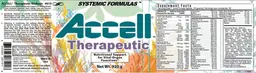
Label for Accell Therapeutic
Open Full PDF View on NIH DSLD →
Details

Label Data

30 Gram(s)
Serving Size
30
Servings
Other Combinations
Product Type
34%
Evidence Coverage
Ingredients

Supplement Facts — Evidence Check

Calories
80 {Calories}
Calories from Fat
1 {Calories}
Total Carbohydrates
10.6 g (2.5% DV)
Protein
9 g (18% DV)
Dietary Fiber
3.5 g (15% DV)
Total Fat
0.16 g (1% DV)
Cholesterol
Sodium
13 mg (1% DV)
Vitamin A
1200 IU (25% DV)
75 IU (300% DV)
3.4× RDA — above typical dose (UL: 1000 mg) 179 studies (A:3, B:90)
20 IU (10% DV)
Market median: 0.03mg (3448 products) 608 studies (A:16, B:251)
Calcium
220 mg (20% DV)
Vitamin C
200 mg (330% DV)
180 mg (1800% DV)
36.0× RDA — above typical dose 2 studies — no high-quality reviews
140 mg (35% DV)
Within RDA (0.3× RDA) 316 studies (A:8, B:159)
90 mg (10% DV)
Within RDA (0.1× RDA) 13 studies (A:0, B:3)
45 mg (2200% DV)
37.5× RDA — above typical dose 76 studies (A:0, B:33)
22 mg (1100% DV)
16.9× RDA — above typical dose (UL: 100 mg) 114 studies (A:3, B:35)
15 mg (100% DV)
Market median: 500.0mg (115 products)
18 mg (1200% DV)
13.8× RDA — above typical dose 13 studies (A:0, B:1)
18 mg (90% DV)
1.3× RDA — within safe limits 196 studies (A:5, B:63)
Iron
10 mg (60% DV)
1.2 mg (60% DV)
Within RDA (0.5× RDA) 9 studies — no high-quality reviews
770 mcg (50% DV)
Within RDA (0.9× RDA) 37 studies (A:0, B:11)
450 mcg (150% DV)
15.0× RDA — above typical dose 27 studies (A:0, B:11)
300 mcg (75% DV)
Within RDA (0.7× RDA) 226 studies (A:10, B:105)
155 mcg (200% DV)
2.8× RDA — within safe limits 173 studies (A:0, B:67)
150 mcg (135% DV)
4.3× RDA — above typical dose 199 studies (A:1, B:55)
45 mcg (30% DV)
Within RDA (0.3× RDA) 245 studies (A:4, B:133)
36 mcg (600% DV)
15.0× RDA — above typical dose 139 studies (A:1, B:44)
30 mcg (40% DV)
Within RDA (0.7× RDA) 3 studies — no high-quality reviews
828 mg
Market median: 2000.0mg (63 products)
Fructooligosaccharide
810 mg
791 mg
Market median: 17.4mg (161 products)
780 mg
Market median: 500.0mg (159 products)
680 mg
Market median: 500.0mg (143 products)
550 mg
Market median: 420.0mg (227 products)
540 mg
Market median: 500.0mg (180 products) 5 studies (A:0, B:1)
Alanine
535 mg
523 mg
Market median: 500.0mg (223 products) 24 studies (A:0, B:1)
Phenylalanine
500 mg
Proline
492 mg
Serine
467 mg
405 mg
Market median: 17.4mg (161 products)
Glycine
380 mg
Valine
367 mg
L-Threonine
300 mg
220 mg
Market median: 500.0mg (193 products) 7 studies — no high-quality reviews
Market median: 600.0mg (7 products) 39 studies (A:2, B:13)
Potassium
220 mg
L-Histidine
200 mg
Hesperidin
150 mg
120 mg
Market median: 500.0mg (70 products)
110 mg
Market median: 500.0mg (19 products)
Sulfur
95 mg
Market median: 100.0mg (284 products) 10 studies (A:0, B:4)
90 mg
Within RDA (0.2× RDA) 38 studies (A:1, B:7)
70 mg
Market median: 550.0mg (217 products) 29 studies (A:0, B:5)
Market median: 1000.0mg (2 products)
L-Carnatine
60 mg
50 mg
Market median: 500.0mg (283 products) 174 studies (A:0, B:62)
Market median: 500.0mg (9 products) 7 studies — no high-quality reviews
Market median: 1000.0mg (1115 products) 24 studies (A:0, B:9)
Trace Minerals
22 mg
15 mg
Market median: 200.0mg (136 products) 3 studies — no high-quality reviews
Pancreatin 3X
9 mg
7 mg
Market median: 108.0mg (8 products) 9 studies (A:0, B:4)
Beta 1,3 Glucan
9 mg
Papain
6 mg
Proprietary Blend (Combination)
4090 mg
Claims

Label Claims — Verification

Unverified All Other
Unverified Structure/Function
Info

Product Information

Directions for Use

Directions For USE: Once per day, mix one level scoop (approximately 30 grams) or four level tablespoons of ACCELL into six fluid ounces of water and drink, followed by an additional glass of water, or take as directed. It is recommended that additional Systemic Formulas BFO, FLX, or other Essential Fatty Acids be taken during the course of a Total Provita Program.

Warnings & Precautions

KEEP OUT OF REACH OF CHILDREN

Additional Information

MADE IN USA

SOLD THROUGH PROFESSIONALS Packed by weight, not volume

Nutritional Support for Vital Organ Functions*

#610 C/12

Systemic Formulas ACCELL provides support for healthy Bowels, Colon, Glandular Functions, Heart, Kidney, Liver and Pancreas. Plus Circulatory, Endocrine, Immune and Respiratory Systems. Specifically designed to provide pivotal support for Doc Wheelwright's Provita Diets. Accell is based on the nutritional theory balanced with rice protein, rice syrup, herbs, vitamins, minerals and amino acids without soy or dairy protein. Enhancing & accelerating the wellness efficiency factors of Systemic Formulas' products including: D, Ds, F+, Ga, Gb, Gf, Gt, H, Hcv, Hn, K, Ks, L, Lb, Ls, M+, P, Ps, R, S, APHA, BLDB, CLNZ, DIJS, DSIR, KDIR, KYRO, BFO, FLX, ENZEE.*

Metadata

Product Details

UPC / SKU6 35585 06101 8
DSLD Entry Date2013-06-25
Product TypeOther Combinations
FormPowder
DSLD ID22284
Data Updated2026-04-11
Research

Research Evidence

7
Research Sources
26
Avg Quality
5
Other
2
Rct
C Para-aminobenzoic acid (PABA) used as a marker for completeness of 24 hour urine: effects of age and dosage scheduling
Rct European journal of clinical nutrition 2003 PubMed
D [The diagnostic value of serum PABA determination in pancreatic disease and in relation to anticholinergic medication]
Rct Gastroenterologisches Journal : Organ der Gesellschaft fur Gastroenterologie der DDR 1989 PubMed
D Para-aminobenzoic acid therapy in scleroderma and lymphoblastoma cutis
Other The Journal of laboratory and clinical medicine 1948 PubMed
F The PABA story
Other The Australasian journal of dermatology 1999 PubMed
F Sodium para-aminobenzoate PABA in the treatment of dermatoses
Other The Journal of investigative dermatology 1952 PubMed
F Para-aminobenzoic acid therapy in lymphoblastoma cutis and mycosis fungoides
Other Cancer 1954 PubMed
F Photochemical formation of singlet molecular oxygen (1O2) in illuminated aqueous solutions of p-aminobenzoic acid (PABA)
Other Journal of photochemistry and photobiology. B, Biology 1996 PubMed
View all evidence for Paba →
Compare

Similar Products

View all Paba products →

This product page is for informational purposes only and does not constitute medical advice. Always consult your healthcare provider before taking any supplement.