Muscle Milk Brownie Batter
This product looks safe
- No ingredients exceed tolerable upper intake levels
- 56% of ingredients have research evidence
What the Evidence Says
AI-generated · Qwen 3.6 · methodologyThe primary components of this product are proteins and carbohydrates, which have strong evidence for supporting muscle recovery and energy levels. Research indicates these macronutrients are effective for maintaining lean mass when combined with exercise. The ingredient profile is generally recognized as safe for consumption.
AI-generated summary based on research evidence. Not medical advice.
Product Label
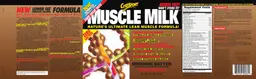
Label Data
Supplement Facts — Evidence Check
Other Ingredients
Label Claims — Verification
Product Information
Directions for Use
Mix two scoops in 10-12 fl. oz. water. Tastes like a real milk shake. BEFORE & DURING WORKOUTS Take MUSCLE MILK one hour prior to workout. For a truly awesome workout, take FAST TWITCH™ Power Workout Drink Mix before and during your workout. AFTER WORKOUTS Take MUSCLE MILK within one hour of completing your workout. After workouts, the body is in a catabolic state. MUSCLE MILK helps reverse this muscle breakdown by providing the necessary nutrients for muscle synthesis.* PRIOR TO BEDTIME Sleep is actually a catabolic period. Remember, breakfast means to "break your fast." During any fast, you break down precious muscle tissue for energy. MUSCLE MILK will help you wake up more anabolic.*
Warnings & Precautions
ALLERGEN STATEMENT: THIS PRODUCT CONTAINS INGREDIENTS DERIVED FROM MILK AND SOY. THIS PRODUCT IS MANUFACTURED IN A PLANT THAT PROCESSES MILK, SOY, WHEAT & EGGS.
Formulation Notes
* MICELLAR PROTEINS STIMULATE MUSCLE SYNTHESIS * LEANLIPIDS(TM) “DESIGNER” FATS PROMOTE LEANNESS * COMPLETE a-ß CASEINS, PEPTIDES and LACTALBUMINS TRIGGER NEW GROWTH * LACTOFERRIN INCREASE OXYGEN DELIVERY * GROWTH PEPTIDES BOOST NITROGEN BALANCE
ADVANCED FORMULA W/FIBER
ZERO LACTOSE
PROTEIN SUPPLEMENT WITH ADDED VITAMINS AND MINERALS
Additional Information
BURN FAT! DON'T STORE IT!* NATURE'S ULTIMATE LEAN MUSCLE FORMULA!
50580-REV1.11/07
NEW LOWER FAT REDUCED CALORIE FORMULA 33% LESS FAT THAN ORIGINAL MUSCLE MILK AMERICAN'S FAVORITE PROTEIN DRINK!
NEW!
SAME GREAT TASTE
NATURALLY and ARTIFICIALLY FLAVORED
FAT CONTENT HAS BEEN REDUCED FROM 18g TO 12g PER SERVING. CALORIES HAVE BEEN REDUCED FROM 350 to 300 PER SERVING.
REFERENCES: 1) Nutrition and Your Health: Dietary Guidelines for Americans. Dietary Guidelines Advisory Committee. 2005. 2) Jensen RG. Lipids in Human Milk. Lipids 1999; 34:1243-1271. 3) Marten B, Pfeuffer M, & Schrezenmeir J. Medium Chain Triglycerides. International Dairy Journal 2006; 16:1374-1382. 4) Connor WE. Importance of n-3 fatty acids in health and disease. Am J Clin Nutr 2000; 71(suppl):171S-175S. 5) Connor WE. alpha- Linolenic acid in health and disease. Am J Clin Nutr 1999; 69(5):827-828. 6) Anderson JW, Smith BM, & Gustafson NJ. Health benefits and practical aspects of high-fiber diets. Am J Clin Nutr 1994; 59(suppl):1242S-7S. 7) Pan D, & Storlien LH. Dietary Lipid Profile Is a Determinant of Tissue Phospholipid Fatty Acid Composition and Rate of Weight Gain in Rats. J. Nutr. 1993; 123:512-519. 8) Bell RR, Spencer MJ, & Sherriff JL. Voluntary Exercise and Monounsaturated Canola Oil Reduce Fat Gain in Mice Fed Diets High in Fat. J. Nutr. 1997; 127:2006-2010. 9) Shimomura Y, Tamura T, & Suzuki M. Less Body Fat Accumulation in Rats Fed a Safflower Oil Diet Than in Rats Fed a Beef Tallow Diet. J. Nutr. 1990; 120:1291-1296.
273027_B
Product Details
Research Evidence
Similar Products
This product page is for informational purposes only and does not constitute medical advice. Always consult your healthcare provider before taking any supplement.