Home/ Supplements/ Betaine/ Betaine HCl

Betaine HCl

product on market Capsule ProThera Safety: 100/100
100/100

This product looks safe

  • No ingredients exceed tolerable upper intake levels
  • Limited research evidence available for ingredients
B Label Compliance Grade
Label

Product Label

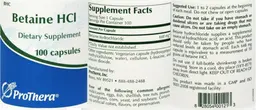
Label for Betaine HCl
Open Full PDF View on NIH DSLD →
Details

Label Data

1 Capsule(s)
Serving Size
100
Servings
Non-Nutrient/Non-Botanical
Product Type
0%
Evidence Coverage
Ingredients

Supplement Facts — Evidence Check

Market median: 496.0mg (192 products) 20 studies — no high-quality reviews

Other Ingredients

Vegetarian Capsule Cellulose L-Leucine Silicon Dioxide
Claims

Label Claims — Verification

Unverified All Other
Info

Product Information

Directions for Use

Suggested use: 1 to 2 capsules at the beginning of each meal. Do not chew or open capsules.

Warnings & Precautions

Caution: Do not take if you have stomach or duodenal ulcers or are taking drugs that may cause ulcers. Do not take on an empty stomach.

Betaine hydrochloride supplies a supplemental source of hydrochloric acid, an acid. This product should only be taken by people who have reduced levels of stomach acid. Each 648 mg capsule is equivalent to a measurement of 10 grains of betaine HCl.

Do not use if full-bottle shrinkwrap is broken or missing.

Keep out of reach of children.

Caution: Do not take if you have stomach or duodenal ulcers or are taking drugs that may cause ulcers.

Formulation Notes

Free of the following common allergens: Milk/casein, eggs, fish, shellfish, tree nuts, peanuts, wheat/gluten, corn, yeast, and soybeans. Contains no artificial colors, flavors, or preservatives.

Betaine hydrochloride supplies a supplemental source of hydrochloric acid, an acid. This product should only be taken by people who have reduced levels of stomach acid. Each 648 mg capsule is equivalent to a measurement of 10 grains of betaine HCl.

Additional Information

Store in a cool, dry place (59(0)F-85(0)F) away from direct light.

This product was made in a GMP and ISO 9001:2008 registered facility.

BHC rev140306B

Metadata

Product Details

UPC / SKU8 28054 00121 3
DSLD Entry Date2017-02-24
Product TypeNon-Nutrient/Non-Botanical
FormCapsule
DSLD ID70904
Data Updated2026-04-11
Research

Research Evidence

23
Research Sources
47
Avg Quality
18
Rct
3
Systematic Review
1
Meta Analysis
1
Clinical Trial
B Effect of Folic Acid, Betaine, Vitamin B₆, and Vitamin B12 on Homocysteine and Dimethylglycine Levels in Middle-Aged Men Drinking White Wine
Rct Nutrients 2016 PubMed DOI
C Betaine for nonalcoholic fatty liver disease: results of a randomized placebo-controlled trial
Rct Hepatology (Baltimore, Md.) 2009 PubMed DOI
C Guidelines for the diagnosis and management of cystathionine beta-synthase deficiency
Systematic Review Journal of inherited metabolic disease 2017 PubMed DOI
C Newborn screening for homocystinurias and methylation disorders: systematic review and proposed guidelines
Systematic Review Journal of inherited metabolic disease 2015 PubMed DOI
C Effects of low-dose B vitamins plus betaine supplementation on lowering homocysteine concentrations among Chinese adults with hyperhomocysteinemia: a randomized, double-blind, controlled preliminary clinical trial
Rct European journal of nutrition 2023 PubMed DOI
C Association of Betaine-Homocysteine S-Methyl Transferase (rs3797546 and rs3733890) polymorphisms with non-syndromic cleft lip/palate: A meta-analysis
Meta Analysis International orthodontics 2019 PubMed DOI
C Two methods for assessment of choline status in a randomized crossover study with varying dietary choline intake in people: isotope dilution MS of plasma and in vivo single-voxel magnetic resonance spectroscopy of liver.
Rct The American journal of clinical nutrition PubMed DOI
C Effect of inulin supplementation on fecal and blood metabolome in alcohol use disorder patients: A randomised, controlled dietary intervention.
Rct Clinical nutrition ESPEN PubMed DOI
C Choline and betaine concentrations in plasma discriminate levels of dietary choline intake in healthy adults: analysis of a double-blind randomized crossover controlled feeding study.
Rct The American journal of clinical nutrition PubMed DOI
C Fibrates may cause an abnormal urinary betaine loss which is associated with elevations in plasma homocysteine
Rct Cardiovascular drugs and therapy 2009 PubMed DOI
View all evidence for Betaine →
Compare

Similar Products

View all Betaine products →

This product page is for informational purposes only and does not constitute medical advice. Always consult your healthcare provider before taking any supplement.