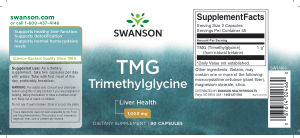
TMG Trimethylglycine 1,000 mg
100/100
This product looks safe
- No ingredients exceed tolerable upper intake levels
- Limited research evidence available for ingredients
B
Label Compliance Grade
Label
Product Label
Details
Label Data
2 Capsule(s)
Serving Size
45
Servings
Non-Nutrient/Non-Botanical
Product Type
0%
Evidence Coverage
Ingredients
Supplement Facts — Evidence Check
1 Gram(s)
Market median: 496.0mg (192 products)
20 studies — no high-quality reviews
Other Ingredients
Gelatin
May contain one or more of the following
Claims
Label Claims — Verification
Unverified
All Other
Unverified
Structure/Function
Info
Product Information
Directions for Use
Suggested use: As a dietary supplement, take two capsules per day with water. Take with first meal of the day, preferably breakfast.
Warnings & Precautions
Warning: For adults only.
Consult your physician before using this or any product if you are pregnant or nursing, taking medication or have a medical condition.
Keep out of reach of children.
Do not use if seal is broken.
Additional Information
Supports healthy liver function Supports detoxification Supports normal homocysteine levels Science-backed quality since 1969
Store in a cool, dry place.
Liver Health
SWU466 Rev 0 02 02 18
Metadata
Product Details
Research
Research Evidence
23
Research Sources
47
Avg Quality
18
Rct
3
Systematic Review
1
Meta Analysis
1
Clinical Trial
B
Effect of Folic Acid, Betaine, Vitamin B₆, and Vitamin B12 on Homocysteine and Dimethylglycine Levels in Middle-Aged Men Drinking White Wine
C
Betaine for nonalcoholic fatty liver disease: results of a randomized placebo-controlled trial
C
Guidelines for the diagnosis and management of cystathionine beta-synthase deficiency
C
Newborn screening for homocystinurias and methylation disorders: systematic review and proposed guidelines
C
Effects of low-dose B vitamins plus betaine supplementation on lowering homocysteine concentrations among Chinese adults with hyperhomocysteinemia: a randomized, double-blind, controlled preliminary clinical trial
C
Association of Betaine-Homocysteine S-Methyl Transferase (rs3797546 and rs3733890) polymorphisms with non-syndromic cleft lip/palate: A meta-analysis
C
Two methods for assessment of choline status in a randomized crossover study with varying dietary choline intake in people: isotope dilution MS of plasma and in vivo single-voxel magnetic resonance spectroscopy of liver.
C
Effect of inulin supplementation on fecal and blood metabolome in alcohol use disorder patients: A randomised, controlled dietary intervention.
C
Choline and betaine concentrations in plasma discriminate levels of dietary choline intake in healthy adults: analysis of a double-blind randomized crossover controlled feeding study.
Compare
Similar Products
Homocystrol + TMG
Douglas Laboratories · Capsule
100
TMG (Trimethylglycine) With Folic Acid & B-12
Kirkman · Capsule
100
Candida Cleanse
Balance One · Capsule
100
HCl with Pepsin
Solaray · Capsule
100
Betaine HCL 250 mg
Solaray · Capsule
100
This product page is for informational purposes only and does not constitute medical advice. Always consult your healthcare provider before taking any supplement.