Home/ Supplements/ Green Tea/ DopaLift

DopaLift

product on market Capsule Adaptogen Research Safety: 100/100
100/100

This product looks safe

  • No ingredients exceed tolerable upper intake levels
  • 80% of ingredients have research evidence
A Label Compliance Grade

What the Evidence Says

AI-generated · Qwen 3.6 · methodology

This formula combines N-Acetyl-L-Tyrosine and Mucuna to support dopamine precursors, alongside Vitamin B-6 as a cofactor. Green tea extract and quercetin provide antioxidant properties, though evidence for this specific combination's efficacy is limited. The profile maintains a high safety score with no significant concerns noted.

AI-generated summary based on research evidence. Not medical advice.

Label

Product Label

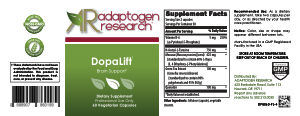
Label for DopaLift
Open Full PDF View on NIH DSLD →
Details

Label Data

2 Capsule(s)
Serving Size
30
Servings
Other Combinations
Product Type
80%
Evidence Coverage
Ingredients

Supplement Facts — Evidence Check

5 mg (250% DV)
3.8× RDA — above typical dose (UL: 100 mg) 114 studies (A:3, B:35)
Market median: 500.0mg (223 products) 24 studies (A:0, B:1)
Mucuna
425 mg
Market median: 260.0mg (249 products) 158 studies (A:4, B:61)
100 mg
Market median: 500.0mg (283 products) 174 studies (A:0, B:62)

Other Ingredients

Cellulose Vegetable Stearate
Claims

Label Claims — Verification

Unverified All Other
Unverified Structure/Function
Info

Product Information

Directions for Use

Recommended Use: As a dietary supplement, take two capsules per day, or as directed by your healthcare practitioner.

Warnings & Precautions

Notice: Color, size or shape may appear different between lots.

Keep out of reach of children.

Report any adverse reactions to 302-213-0030

Formulation Notes

Made with Non-GMO Ingredients Does not contain gluten

Brain Support

Manufactured in a GMP Registered facility in the USA

Additional Information

Professional Use Only

Store at room temperature.

Guaranteed GMP Compliant Products

Metadata

Product Details

UPC / SKU0 688907 860189
DSLD Entry Date2021-04-22
Product TypeOther Combinations
FormCapsule
DSLD ID246953
Data Updated2026-04-11
Research

Research Evidence

188
Research Sources
56
Avg Quality
101
Meta Analysis
58
Systematic Review
15
Clinical Trial
13
Rct
1
Openfda Safety
A The effect of Green green tea consumption on body mass index, lipoprotein, liver enzymes, and liver cancer: An updated systemic review incorporating a meta-analysis
Meta Analysis Critical reviews in food science and nutrition 2024 PubMed DOI
A Green Tea Consumption and Risk of Breast Cancer and Recurrence-A Systematic Review and Meta-Analysis of Observational Studies
Meta Analysis Nutrients 2018 PubMed DOI
A Green tea (Camellia sinensis) for the prevention of cancer
Meta Analysis The Cochrane database of systematic reviews 2020 PubMed DOI
A The Effect of Antioxidant Polyphenol Supplementation on Cardiometabolic Risk Factors: A Systematic Review and Meta-Analysis
Meta Analysis Nutrients 2024 PubMed DOI
B Green tea for weight loss and weight maintenance in overweight or obese adults
Meta Analysis The Cochrane database of systematic reviews 2012 PubMed DOI
B Green tea consumption and risk of pancreatic cancer: a meta-analysis
Meta Analysis Nutrients 2014 PubMed DOI
B Safety and Effectiveness of Oral Nutraceuticals for Treating Acne: A Systematic Review
Systematic Review JAMA dermatology 2023 PubMed DOI
B Dietary Strategies for Weight Loss Maintenance
Meta Analysis Nutrients 2019 PubMed DOI
B Green and black tea for the primary prevention of cardiovascular disease
Meta Analysis The Cochrane database of systematic reviews 2013 PubMed DOI
B Risk factors for stomach cancer: a systematic review and meta-analysis
Meta Analysis Epidemiology and health 2020 PubMed DOI
View all evidence for Green Tea →
Compare

Similar Products

View all Green Tea products →

This product page is for informational purposes only and does not constitute medical advice. Always consult your healthcare provider before taking any supplement.