Home/ Supplements/ Green Tea/ DopaBoost

DopaBoost

product on market Capsule Designs for Health Safety: 100/100
100/100

This product looks safe

  • No ingredients exceed tolerable upper intake levels
  • 80% of ingredients have research evidence
A Label Compliance Grade

What the Evidence Says

AI-generated · Qwen 3.6 · methodology

This formula combines B-6 and N-Acetyl-L-Tyrosine, which are precursors and cofactors for dopamine synthesis. Macuna and green tea extract provide additional dopaminergic support, though evidence for these specific combinations is limited. Overall, the ingredients are generally recognized as safe for use.

AI-generated summary based on research evidence. Not medical advice.

Label

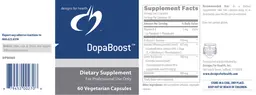
Product Label

Label for DopaBoost
Open Full PDF View on NIH DSLD →
Details

Label Data

2 Capsule(s)
Serving Size
30
Servings
Other Combinations
Product Type
80%
Evidence Coverage
Ingredients

Supplement Facts — Evidence Check

5 mg (250% DV)
3.8× RDA — above typical dose (UL: 100 mg) 114 studies (A:3, B:35)
Market median: 500.0mg (223 products) 24 studies (A:0, B:1)
Macuna
425 mg
Market median: 260.0mg (249 products) 158 studies (A:4, B:61)
100 mg
Market median: 500.0mg (283 products) 174 studies (A:0, B:62)

Other Ingredients

Microcrystalline Cellulose Vegetable Stearate
Claims

Label Claims — Verification

Unverified All Other
Info

Product Information

Directions for Use

Recommended Use: As a dietary supplement, take two capsules daily, or as directed by your health care practitioner.

Warnings & Precautions

KEEP OUT OF REACH OF CHILDREN.

Additional Information

For Professional Use Only

Manufactured in a GMP CERTIFIED Facility

STORE IN A COOL, DRY PLACE.

Notice: Color, size or shape may appear different between lots.

DPB060

Metadata

Product Details

UPC / SKU8 79452 00270 8
DSLD Entry Date2013-07-25
Product TypeOther Combinations
FormCapsule
DSLD ID22394
Data Updated2026-04-11
Research

Research Evidence

188
Research Sources
56
Avg Quality
101
Meta Analysis
58
Systematic Review
15
Clinical Trial
13
Rct
1
Openfda Safety
A The effect of Green green tea consumption on body mass index, lipoprotein, liver enzymes, and liver cancer: An updated systemic review incorporating a meta-analysis
Meta Analysis Critical reviews in food science and nutrition 2024 PubMed DOI
A Green Tea Consumption and Risk of Breast Cancer and Recurrence-A Systematic Review and Meta-Analysis of Observational Studies
Meta Analysis Nutrients 2018 PubMed DOI
A Green tea (Camellia sinensis) for the prevention of cancer
Meta Analysis The Cochrane database of systematic reviews 2020 PubMed DOI
A The Effect of Antioxidant Polyphenol Supplementation on Cardiometabolic Risk Factors: A Systematic Review and Meta-Analysis
Meta Analysis Nutrients 2024 PubMed DOI
B Green tea for weight loss and weight maintenance in overweight or obese adults
Meta Analysis The Cochrane database of systematic reviews 2012 PubMed DOI
B Green tea consumption and risk of pancreatic cancer: a meta-analysis
Meta Analysis Nutrients 2014 PubMed DOI
B Safety and Effectiveness of Oral Nutraceuticals for Treating Acne: A Systematic Review
Systematic Review JAMA dermatology 2023 PubMed DOI
B Dietary Strategies for Weight Loss Maintenance
Meta Analysis Nutrients 2019 PubMed DOI
B Green and black tea for the primary prevention of cardiovascular disease
Meta Analysis The Cochrane database of systematic reviews 2013 PubMed DOI
B Risk factors for stomach cancer: a systematic review and meta-analysis
Meta Analysis Epidemiology and health 2020 PubMed DOI
View all evidence for Green Tea →
Compare

Similar Products

View all Green Tea products →

This product page is for informational purposes only and does not constitute medical advice. Always consult your healthcare provider before taking any supplement.