Betaine HCl
100/100
This product looks safe
- No ingredients exceed tolerable upper intake levels
- Limited research evidence available for ingredients
B
Label Compliance Grade
Label
Product Label
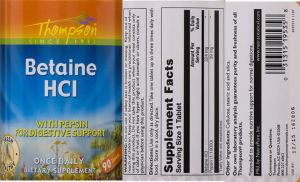
Details
Label Data
1 Tablet(s)
Serving Size
Non-Nutrient/Non-Botanical
Product Type
0%
Evidence Coverage
Ingredients
Supplement Facts — Evidence Check
324 mg
Market median: 496.0mg (192 products)
20 studies — no high-quality reviews
Pepsin
39 mg
Other Ingredients
Cellulose
Stearic Acid
Silica
Claims
Label Claims — Verification
Unverified
All Other
Info
Product Information
Directions for Use
Directions: Use only as directed. Take one tablet up to three times daily with food.
Warnings & Precautions
WARNING: Do not use if safety seal is broken or missing.
Keep out of reach of children.
Do not take this product when your meal consists only of salad or fruit. If you have hyper (high) acid stomach or ulcers, consult a physician before using this product.
Formulation Notes
WITH PEPSIN FOR DIGESTIVE SUPPORT
Additional Information
FRESH HEALTHY
ONCE DAILY
Keep your licensed health care practitioner informed when using this product.
Store in a cool, dry place.
Intended to provide nutritive support for normal digestion.
6247312 1107
SINCE 1932
Metadata
Product Details
Research
Research Evidence
23
Research Sources
47
Avg Quality
18
Rct
3
Systematic Review
1
Meta Analysis
1
Clinical Trial
B
Effect of Folic Acid, Betaine, Vitamin B₆, and Vitamin B12 on Homocysteine and Dimethylglycine Levels in Middle-Aged Men Drinking White Wine
C
Betaine for nonalcoholic fatty liver disease: results of a randomized placebo-controlled trial
C
Guidelines for the diagnosis and management of cystathionine beta-synthase deficiency
C
Newborn screening for homocystinurias and methylation disorders: systematic review and proposed guidelines
C
Effects of low-dose B vitamins plus betaine supplementation on lowering homocysteine concentrations among Chinese adults with hyperhomocysteinemia: a randomized, double-blind, controlled preliminary clinical trial
C
Association of Betaine-Homocysteine S-Methyl Transferase (rs3797546 and rs3733890) polymorphisms with non-syndromic cleft lip/palate: A meta-analysis
C
Two methods for assessment of choline status in a randomized crossover study with varying dietary choline intake in people: isotope dilution MS of plasma and in vivo single-voxel magnetic resonance spectroscopy of liver.
C
Effect of inulin supplementation on fecal and blood metabolome in alcohol use disorder patients: A randomised, controlled dietary intervention.
C
Choline and betaine concentrations in plasma discriminate levels of dietary choline intake in healthy adults: analysis of a double-blind randomized crossover controlled feeding study.
Compare
Similar Products
TMG-15 Complex 500
LifeLink · Tablet or Pill
100
Betaine HCL and Pepsin
Endo-met Laboratories · Tablet or Pill
100
Digest Support
Maxi Health · Tablet or Pill
100
Super-Gest
Viva Vitamins · Tablet or Pill
100
Super Enzymes
KAL · Tablet or Pill
100
This product page is for informational purposes only and does not constitute medical advice. Always consult your healthcare provider before taking any supplement.