Creatine Monohydrate
This product looks safe
- No ingredients exceed tolerable upper intake levels
- 100% of ingredients have research evidence
What the Evidence Says
AI-generated · Qwen 3.6 · grounded in 1 source · methodologyCreatine monohydrate is supported by strong evidence for increasing muscle mass and enhancing athletic performance. Research indicates it helps replenish ATP levels to improve strength and power output during high-intensity exercise. This ingredient is widely recognized as safe for most healthy individuals.
AI-generated summary based on research evidence. Not medical advice.
Product Label
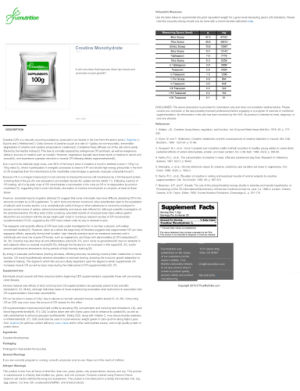
Label Data
Supplement Facts — Evidence Check
Label Claims — Verification
Product Information
Directions for Use
CR can be taken in doses of 2-5g / day to elevate or maintain elevated muscle creatine levels(12, 44, 45).
CEE could be taken with with alpha lipoic acid to enhance its uptake(48), as well as with carbohydrate to enhance glycogen synthesis(49). Taking CEE, along with vitamin C, may reduce muscle soreness or inflammation(26, 27). CEE could also be used in a post-workout, weight gainer or carb-up drink along alpha lipoic acid, arginine (to optimize nutrient delivery), waxy maize and/or other carbohydrate source, and a high quality protein or protein blend.
Warnings & Precautions
Supplement Use Individuals should consult with their physician before beginning CEE supplementation, especially those with pre-existing renal disease. Adverse medical side effects of short and long-term CR supplementation are generally absent in the scientific literature(13, 23, 38-42), although individual cases of those experiencing reversable renal dysfunction in association with CR supplementation have been reported(43).
General warnings If you are currently pregnant or nursing, consult a physician prior to use.
Keep out of reach of children.
This product is manufactured in a facility that handles soy, gluten, and milk products.
This product is manufactured in a facility that handles milk, soy, egg, peanut, nut, tree, fish, crustaceans/shellfish, and wheat products.
Formulation Notes
Ingredients Creatine Monohydrate.
Allergen warnings This product is free from all forms of shell fish, tree nuts, yeast, gluten, salt, preservatives, lactose, and soy.
Products ordered using premium flavor systems will contain artificial flavoring and sweeteners.
Additional Information
Truenutrition.com Be true to yourself.
A cell-volumizer that improves blood lipid levels and promotes muscle growth!
Description Creatine (CR) is a naturally occurring substance, produced in our bodies in the liver from the amino acids L-arginine, L-glycine and L-methionine (1). Daily turnover of creatine occurs at a rate of -2g/day via non-enzymatic, irreversible degradation of creatine and creatine phosphate to creatinine(2). Creatinine freely diffuses out of the cell and is easily filtered by the healthy kidney(3). This loss is normaly replaced by endogenous CR synthesis, as well as exogenous (dietary) sources of creatine such as meat(4). However, vegetarians typically have lower levels of creatine in serum and muscle(5), and experience a greater elevation in muscle CR following dietary supplementation(6). Due in part to its relatively large mass, over 95% of the body's store of creatine is found in skeletal mmuscle (-120g in a 70kg male(1), where it participates in energetic processes to restore ATp and shuttle high energy phosphate in the form of CR phosphate from the mitochondria to the myofibrillar cross-bridges to generate muscular contractile force(7). Because CR is a charged molecule(2) it must normally be transported across cell membranes by a CR transport protein, including that of the gut (for oral absorption) and skeletal muscle (for uptake into the cell)(8-11). Following a period of CR loading, all of a 5g daily dose of CR monohydrate is recoverable in the urine as CR or its degradative by-product creatinine(12), suggesting that in most individuals, absorption of creatine monohydrate is complete, at least at these doses.
However, anecdotal reports of gastric distress(13) suggest that some individuals may have difficulty absorbing CR in the amounts provided by a CR supplement. To aid in trans-membrane movement, ethyl esterification (akin to the acetylation of salicylic acid to make aspirin, a.k.a acetylsalycylic acid) of drugs or other substances is commonly employed to bypass normal means of uptake, enhance bioavailability and reduce side effects(14). Although scientific investigation of the pharmacokinetics CR ethyl ester (CEE) is lacking, anecdotal reports of increased body mass without gastric discomfort are consistent with the abrupt weight gain noted in numerous research studies of CR monohydrate supplementation (15-22), suggesting the CEE does indeed make its way to skeletal muscle. The ergogenic and anabolic effects of CR have been under investigation for more than a decade, with widely inconsistent results(23). However, taken as a whole the large body of literature suggests that supplement CR can have ergogenic effects, especially during brief duration, high intensity exercise (such as resistance exercise) and in individuals who have low muscle CR levels, such as vegetarians, and those with abnormalities of CR metabolism(21,24,25).
Creatine may also have an anti-inflammatory action(26,27), aid in nerve re-generation(28) have an anaboic or anti-catabolic effect on skeletal muscle(29-32), although the literature is not consistent in this regard(33,34), and/or prevent performance decrements during periods of high intensity training(35). By aiding in muscular performance (training stimulus), affecting recovery via altering muscle protein metabolism or nerve function, CR would hypothetically enhance adaptation to exercise training, including the muscular growth adaptation to resistance training. The degree to which this occurs is likely dependent upon the degree to which supplemental CR increases muscle CR as well as body mass during the initial period of CR supplementation(36,37).
Consuming CR as CEE may even lower the amount of CR needed for this effect. CR supplementation improves blood lipid profile be elevating HDL concentration and reducing total cholesterol, LDL, and blood triglyceride levels(46, 47).
Packaging Packaged in heat-sealed foil pouches.
Volumetric measures Use the table below to approximate the gram equivalent weight for a given level measuring spoon (US Standard). Please note that accurate dosing should only be done with a recommended calibrated scale. Measuring spoon (level) g mg 90cc Scoop 47.3 47331 70cc Scoop 36.8 36813 29.6cc Scoop 15.6 15567 25cc Scoop 13.1 13147 Tablespoon 7.8 7778 10cc Scoop 5.3 5259 1/2 Tablespoon 3.9 3889 Teaspoon 2.6 2593 1/2 Teaspoon 1.3 1296 1.7cc Scoop 0.69 894 1/4 Teaspoon 0.6 648 1/8 Teaspoon 0.3 324 1/16 Teaspoon 0.2 162 1/32 Teaspoon 0.1 81
References 1. Walker, J.B., Creatine: biosynthesis, regulation, and function. Adv Enzymol Relat Areas Mol Biol, 1979. 50: p. 177-242. 2. Wyss, M. and T. Wallimann, Creatine metabolism and the consequences of creatine depletion in muscle. Mol. Cell. Biochem., 1994. 133/134: p. 51-66. 3. Hogwerf, B.J., et al., Urine C-peptide and creatinine (Jaffe method) excretion in healthy young adults on varied diets: sustained effects of varied carbohydrate, protein, and meat content. AM J Cin Nutr. 1986. 43(3): p. 350-60. 4. Harris, R.C., et al., The concentration of creatine in meat, offal and commercial dog food. Research in Veterinary Science, 1997. 62(1): p. 58-62. 5.Delanghe, j., et al., Normal reference values for creatine, creatinine, and carnitine are lower in vegetarians. Clin Chem, 1989, 35(8): p. 1802-3. 6. Harris, R.C., et al., Elevation of creatine in resting and exercised muscle of normal subjects be creatine supplementation. Clin. Sci.(Colch). 1992. 83: p. 367-374. 7. Bessman, S.P. and F. Savabi, The role of the phosphcreatine energy shuttle in exercise and muscle hypertrophy, in Proceedings of the 7th International Biochemistry of Exercise Conference held on June 1-4, 1988 in London, Ontario, Canada, A.W. Taylor, Editor. 1990, Human Kinetics Publishers: Champaign, IL. p. 167-178.
True Nutrition was established on the values of our customers not the owner's wallets. True Nutrition absolutely refuses to cut any corners when it comes to product quality, product validity and product manufacturing.
Product Details
Research Evidence
Similar Products
This product page is for informational purposes only and does not constitute medical advice. Always consult your healthcare provider before taking any supplement.