🟡 60/100

Review before taking

  • Vitamin B3: 500mg is 14.3× the Tolerable Upper Intake Level (35mg)
  • 100% of ingredients have research evidence
C Label Compliance Grade

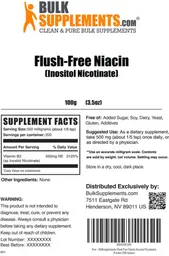
Product Label

📸

Have a supplement label? Find it here.

Upload a photo of any supplement label to search our database of 92,312 products.

Safety Alerts

⚠️ Vitamin B3: 500mg is 14.3× the Tolerable Upper Intake Level (35mg)

The safety score is low because the amount of Vitamin B3 in this supplement is over 14 times the recommended daily upper limit of 35mg.

Label Data

500 mg Serving Size
200 Servings
Vitamin Product Type
100% Evidence Coverage

Supplement Facts — Evidence Check

500 mg NE (3125% DV)
⚠️ Exceeds Tolerable Upper Intake Level by 14.3× (UL: 35 mg) 📚 193 studies (Tier A: 5, B: 63)
RDA 14mg This product: 500mg UL 35mg

Label Claims — Verification

All Other
Structure/Function
All Other (99% of products) Structure/Function (78% of products) Nutrient (22% of products)

Target Groups

Adult (18 - 50 Years) Gluten Free Dairy Free

Product Information

📋 Directions for Use

Suggested use: As a dietary supplement, take 500 mg (about 1/5 tsp) once daily, or as directed by a physician.

⚠️ Warnings & Precautions

Always consult a physician before taking any dietary supplement.

Keep out of reach of children.

🧪 Formulation Notes

Free of: added sugar, soy, dairy, yeast, gluten, additives

Additional Information

Contents are sold by weight, not volume. Settling may occur.

Store in a dry, cool, dark place.

Use an accurate milligram scale. New

Product Details

UPC / SKU X0019ME39N
DSLD Entry Date 2024-05-23
Product Type Vitamin
Form Powder
DSLD ID 312498
Data Updated 2026-04-11

Research Evidence

32 Research Sources
50 Avg Quality Score
19 Rct
7 Meta Analysis
3 Clinical Trial
2 Other
1 Systematic Review
B Greater Choline-Containing Compounds and Myo-inositol in Treatment-Resistant Versus Responsive Schizophrenia: A 1H-Magnetic Resonance Spectroscopy Meta-analysis
Meta Analysis Biological psychiatry. Cognitive neuroscience and neuroimaging 2024
B Inositol for Polycystic Ovary Syndrome: A Systematic Review and Meta-analysis to Inform the 2023 Update of the International Evidence-based PCOS Guidelines
Meta Analysis The Journal of clinical endocrinology and metabolism 2024
B Antenatal dietary supplementation with myo-inositol for preventing gestational diabetes
Meta Analysis The Cochrane database of systematic reviews 2023
B Effectiveness of inositol, metformin and their combination in women with PCOS undergoing assisted reproduction: systematic review and meta-analysis
Meta Analysis Gynecological endocrinology : the official journal of the International Society of Gynecological Endocrinology 2022
B Effects of myo-inositol vs. metformin on hormonal and metabolic parameters in women with PCOS: a meta-analysis
Meta Analysis Irish journal of medical science 2023
B Inositol for subfertile women with polycystic ovary syndrome
Meta Analysis The Cochrane database of systematic reviews 2018
B Treatment of lean PCOS teenagers: a follow-up comparison between Myo-Inositol and oral contraceptives
Rct European review for medical and pharmacological sciences 2021
B The 40:1 myo-inositol/D-chiro-inositol plasma ratio is able to restore ovulation in PCOS patients: comparison with other ratios
Rct European review for medical and pharmacological sciences 2019
C Investigating the effect of combined use of selenium and Myo-inositol supplements on thyroid function and autoimmune characteristics in thyroid disorders: a systematic review and meta-analysis
Meta Analysis Expert review of endocrinology & metabolism 2024
C Myo-inositol supplementation to prevent gestational diabetes in overweight non-obese women: bioelectrical impedance analysis, metabolic aspects, obstetric and neonatal outcomes - a randomized and open-label, placebo-controlled clinical trial.
Rct International journal of food sciences and nutrition
View all evidence for Inositol →

Compare Similar Products

View all Inositol products →