🟢 100/100

This product looks safe

  • No ingredients exceed tolerable upper intake levels
  • Limited research evidence available for ingredients
B Label Compliance Grade

Product Label

📸

Have a supplement label? Find it here.

Upload a photo of any supplement label to search our database of 92,312 products.

Label Data

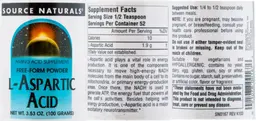
0.25 Teaspoon(s) Serving Size
52 Servings
Amino acid/Protein Product Type
0% Evidence Coverage

Supplement Facts — Evidence Check

Calories
10 Calorie(s)
1.9 Gram(s)
📊 Market median: 2000.0mg (63 products)
Median 2000.0mg This product: 1.9mg

Label Claims — Verification

Nutrient
All Other
Structure/Function
All Other (97% of products) Structure/Function (94% of products) Nutrient (48% of products) No Claim (2% of products)

Target Groups

Vegetarian Adult (18 - 50 Years) Gluten Free Dairy Free Sugar Free

Product Information

📋 Directions for Use

Suggested Use: 1/4 to 1/2 teaspoon daily between meals.

⚠️ Warnings & Precautions

Do not use if either tamper-evident seal is broken or missing.

Keep out of the reach of children.

🧪 Formulation Notes

Free-form powder

L-Aspartic acid plays a vital role in energy production. It is one of the components necessary to move high-energy NADH molecules from the main body of a cell to its mitochondria, or primary energy-production areas. Once there, the NADH is used to generate ATP, the energy fuel that powers all the cell's activities. Besides helping with energy production, L-Aspartic acid is a major excitatory neurotransmitter.

Suitable for vegetarians and hypoallergenic: contains no yeast, dairy, egg, gluten, corn, soy or wheat.

Suitable for vegetarians and hypoallergenic: contains no yeast, dairy, egg, gluten, corn, soy or wheat. Contains no sugar, starch, salt, preservatives, or artificial color, flavor or fragrance.

Suitable for vegetarians and hypoallergenic: contains no yeast, dairy, egg, gluten, corn, soy or wheat.

Product Details

UPC / SKU 0 21078 00167 6
DSLD Entry Date 2023-08-23
Product Type Amino acid/Protein
Form Powder
DSLD ID 295936
Data Updated 2026-04-11

Research Evidence

9 Research Sources
37 Avg Quality Score
5 Rct
4 Other
C The Effects of Six-Gram D-Aspartic Acid Supplementation on the Testosterone, Cortisol, and Hematological Responses of Male Boxers Subjected to 11 Days of Nocturnal Exposure to Normobaric Hypoxia
Rct Nutrients 2023
C Using an experimental medicine model to understand the antidepressant potential of the N-Methyl-D-aspartic acid (NMDA) receptor antagonist memantine
Rct Journal of psychopharmacology (Oxford, England) 2012
C The effects of d-aspartic acid supplementation in resistance-trained men over a three month training period: A randomised controlled trial
Rct PloS one 2017
C Short-Term d-Aspartic Acid Supplementation Does Not Affect Serum Biomarkers Associated With the Hypothalamic-Pituitary-Gonadal Axis in Male Climbers
Rct International journal of sport nutrition and exercise metabolism 2019
C Combined melatonin and adrenocorticotropic hormone treatment attenuates N-methyl-d-aspartate-induced infantile spasms in a rat model by regulating activation of the HPA axis
Other Neuroscience letters 2021
D A placebo-controlled randomized crossover trial of the N-methyl-D-aspartic acid receptor antagonist, memantine, in patients with chronic phantom limb pain
Rct Anesthesia and analgesia 2004
D The efficacy of adrenocorticotropic hormone in a girl with anti-N-methyl-D-aspartate receptor encephalitis
Other Brain & development 2018
D The role and molecular mechanism of D-aspartic acid in the release and synthesis of LH and testosterone in humans and rats
Other Reproductive biology and endocrinology : RB&E 2009
F Blockage of N-methyl-D-aspartate receptors decreases testosterone levels and enhances postnatal neuronal apoptosis in the preoptic area of male rats
Other Neuroendocrinology 2000
View all evidence for D Aspartic Acid →

Compare Similar Products

View all D Aspartic Acid products →