Clarity

product on market Unknown Thesis Safety: 100/100
100/100

This product looks safe

  • No ingredients exceed tolerable upper intake levels
  • 25% of ingredients have research evidence
B Label Compliance Grade

What the Evidence Says

AI-generated · Qwen 3.6 · methodology

This profile combines Alpha GPC and Lion's Mane, which have moderate evidence for supporting cognitive function and memory. Camellia sinensis and 7,8-Dihydroxyflavone are included for neuroprotective properties, though clinical evidence for the latter remains limited. The formulation maintains a high safety profile based on the provided data.

AI-generated summary based on research evidence. Not medical advice.

Label

Product Label

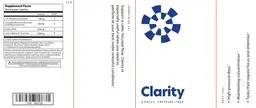
Label for Clarity
Open Full PDF View on NIH DSLD →
Details

Label Data

1 Packet(s)
Serving Size
6
Servings
Other Combinations
Product Type
25%
Evidence Coverage
Ingredients

Supplement Facts — Evidence Check

7,8-Dihydroxyflavone
30 mg
Market median: 260.0mg (249 products) 158 studies (A:4, B:61)
Alpha GPC
250 mg
Lion's Mane extract
500 mg

Other Ingredients

Magnesium Stearate Microcrystalline Cellulose Rice Flour Silicon Dioxide Stearic Acid
Claims

Label Claims — Verification

Unverified All Other
Unverified Structure/Function
Info

Product Information

Warnings & Precautions

Caution: Do not take more than 2 packets in a 24 hour period.

Do not use if you are pregnant, nursing or under the age of 18. Consult your healthcare professional before use if you have a medical condition or are taking medication.

Do not use if you are pregnant, nursing or under the age of 18. Keep out of reach of children.

Formulation Notes

Formulated to: Support a calm, focused flow. Clarity is especially useful when you need to perform at your best under stressful conditions.

Caffeine-free

Best for: High-pressure days Maintaining concentration Tasks that require focus and attention

Metadata

Product Details

UPC / SKUTHS - 000106
DSLD Entry Date2022-10-24
Product TypeOther Combinations
FormUnknown
BrandThesis
DSLD ID278271
Data Updated2026-04-11
Research

Research Evidence

188
Research Sources
56
Avg Quality
101
Meta Analysis
58
Systematic Review
15
Clinical Trial
13
Rct
1
Openfda Safety
A The effect of Green green tea consumption on body mass index, lipoprotein, liver enzymes, and liver cancer: An updated systemic review incorporating a meta-analysis
Meta Analysis Critical reviews in food science and nutrition 2024 PubMed DOI
A Green Tea Consumption and Risk of Breast Cancer and Recurrence-A Systematic Review and Meta-Analysis of Observational Studies
Meta Analysis Nutrients 2018 PubMed DOI
A Green tea (Camellia sinensis) for the prevention of cancer
Meta Analysis The Cochrane database of systematic reviews 2020 PubMed DOI
A The Effect of Antioxidant Polyphenol Supplementation on Cardiometabolic Risk Factors: A Systematic Review and Meta-Analysis
Meta Analysis Nutrients 2024 PubMed DOI
B Green tea for weight loss and weight maintenance in overweight or obese adults
Meta Analysis The Cochrane database of systematic reviews 2012 PubMed DOI
B Green tea consumption and risk of pancreatic cancer: a meta-analysis
Meta Analysis Nutrients 2014 PubMed DOI
B Safety and Effectiveness of Oral Nutraceuticals for Treating Acne: A Systematic Review
Systematic Review JAMA dermatology 2023 PubMed DOI
B Dietary Strategies for Weight Loss Maintenance
Meta Analysis Nutrients 2019 PubMed DOI
B Green and black tea for the primary prevention of cardiovascular disease
Meta Analysis The Cochrane database of systematic reviews 2013 PubMed DOI
B Risk factors for stomach cancer: a systematic review and meta-analysis
Meta Analysis Epidemiology and health 2020 PubMed DOI
View all evidence for Green Tea →
Compare

Similar Products

View all Green Tea products →

This product page is for informational purposes only and does not constitute medical advice. Always consult your healthcare provider before taking any supplement.