Home/ Supplements/ Aloe Vera/ Aloe Vera

Aloe Vera

product on market Tablet or Pill Douglas Laboratories Safety: 100/100
100/100

This product looks safe

  • No ingredients exceed tolerable upper intake levels
  • 100% of ingredients have research evidence
A Label Compliance Grade

What the Evidence Says

AI-generated · Qwen 3.6 · grounded in 1 source · methodology

Aloe vera powder is researched for its potential to support digestive health and skin integrity. Current clinical evidence for these systemic effects is generally limited. The ingredient profile maintains a high safety rating for typical supplemental use.

AI-generated summary based on research evidence. Not medical advice.

Label

Product Label

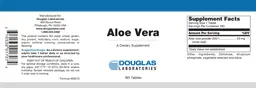
Label for Aloe Vera
Open Full PDF View on NIH DSLD →
Details

Label Data

1 Tablet(s)
Serving Size
180
Servings
Botanical
Product Type
100%
Evidence Coverage
Ingredients

Supplement Facts — Evidence Check

Market median: 100.0mg (166 products) 11 studies (A:0, B:1)

Other Ingredients

Cellulose Dicalcium Phosphate Vegetable Stearate Silica
Claims

Label Claims — Verification

Unverified All Other
Info

Product Information

Directions for Use

Suggested Usage: As a dietary supplement, adults take 1 tablet daily or as directed by your healthcare professional.

Warnings & Precautions

KEEP OUT OF REACH OF CHILDREN.

Tamper resistant package, do not use if outer seal is missing.

Formulation Notes

This product contains NO yeast, wheat, gluten, soy protein, milk/dairy, corn, sodium, sugar, starch, artificial coloring, preservatives or flavoring.

Additional Information

For optimal storage conditions, store in a cool, dry place. (59(0)-77(0)F/ 15(0)-25(0)C) (35-65% relative humidity)

Formula #80070

Metadata

Product Details

UPC / SKU3 10539 01707 4
DSLD Entry Date2014-02-26
Product TypeBotanical
FormTablet or Pill
DSLD ID30712
Data Updated2026-04-11
Research

Research Evidence

13
Research Sources
48
Avg Quality
7
Rct
4
Systematic Review
1
Meta Analysis
1
Clinical Trial
B Aloe vera for prevention and treatment of infusion phlebitis
Meta Analysis The Cochrane database of systematic reviews 2014 PubMed DOI
B Aloe vera gel and cesarean wound healing; a randomized controlled clinical trial
Rct Global journal of health science 2014 PubMed DOI
C The use of babosa (Aloe vera) in treating burns: a literature review
Systematic Review Brazilian journal of biology = Revista brasleira de biologia 2021 PubMed DOI
C Topical Aloe Vera Gel for Accelerated Wound Healing of Split-Thickness Skin Graft Donor Sites: A Double-Blind, Randomized, Controlled Trial and Systematic Review
Systematic Review Plastic and reconstructive surgery 2018 PubMed DOI
C The efficacy of aloe vera used for burn wound healing: a systematic review
Systematic Review Burns : journal of the International Society for Burn Injuries 2007 PubMed
C Effects of Aloe Sterol Supplementation on Skin Elasticity, Hydration, and Collagen Score: A 12-Week Double-Blind, Randomized, Controlled Trial
Rct Skin pharmacology and physiology 2016 PubMed DOI
C Effects of low-dose Aloe sterol supplementation on skin moisture, collagen score and objective or subjective symptoms: 12-week, double-blind, randomized controlled trial
Rct The Journal of dermatology 2020 PubMed DOI
C Effectiveness of Aloe Vera gel compared with 1% silver sulphadiazine cream as burn wound dressing in second degree burns
Rct JPMA. The Journal of the Pakistan Medical Association 2013 PubMed
C Evaluation of the Remineralizing Effect of Aloe Vera Versus Diode Laser for Management of Deep Carious Lesions.
Clinical Trial ClinicalTrials.gov 2021
C Phase III double-blind evaluation of an aloe vera gel as a prophylactic agent for radiation-induced skin toxicity
Rct International journal of radiation oncology, biology, physics 1996 PubMed
View all evidence for Aloe Vera →
Compare

Similar Products

View all Aloe Vera products →

This product page is for informational purposes only and does not constitute medical advice. Always consult your healthcare provider before taking any supplement.