Propolis Throat Spray
This product looks safe
- No ingredients exceed tolerable upper intake levels
- Limited research evidence available for ingredients
Product Label
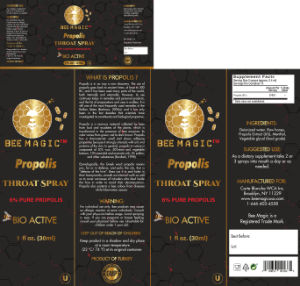
Label Data
Supplement Facts — Evidence Check
Other Ingredients
Label Claims — Verification
Product Information
Directions for Use
Suggested use: As a dietary supplement take 2 or 3 sprays into mouth a day or as needed.
Warnings & Precautions
Warning: For individual use only.
Could cause an allergic reaction at some individuals.
Consult with your physician before usage. Avoid spraying in eyes.
If you are pregnant or breastfeeding consult your physician before use.
Unsuitable for children under 1 years old. Keep out of the reach children.
Bee products may cause an allergic reaction at some individuals.
Formulation Notes
Product of Turkey
Dry content minimum 6%
Bio Active
OU (Kosher)
6% pure propolis
What is propolis? Propolis is in no way a new discovery. The use of propolis goes back to ancient times, at least to 300 BC, and it has been used many parts of the world, both internally and externally. However, its use continues today in remedies and personal products, and the list of preparations and uses is endless. It is still one of the most frequently used remedies in the Balkan States (Bankova, 2005a), and it has only been investigated its constituents and biological properties. Propolis is a resinous material collected by bees from bed and exudates of the plants, which is transformed in the presence of bee enzymes. Its color varies from green, red to dark brown. Propolis has a characteristic smell and shows adhesive properties because it strongly interacts with oils and proteins of the skin. In general, propolis in nature is composed of 30% wax, 50% resin and vegetable balsam, 10% essential and aromatic oils, 5% pollen, and other substances (Burdock, 1998) Etymologically, the Greek word propolis means pro, for or in defense, and polis, the city, that is "defense of the hive". Bees use it to seal holes in their honeycombs, smooth out internal walls as well as to cover carcasses of intruders who died inside the hive in order to avoid their decomposition. Propolis also protects a bee colony from diseases while hibernation season.
Additional Information
Keep product in a shadow and dry place at a room temperature (22 degrees C/74 degrees F) at it original container.
GMP Sourced from a GMP Certified Facility
OU (Kosher)
Product Details
Research Evidence
We're building the evidence profile for this product's ingredients. Check back soon.
This product page is for informational purposes only and does not constitute medical advice. Always consult your healthcare provider before taking any supplement.