Home/ Supplements/ Paba/ PABA 100 mg

PABA 100 mg

product on market Tablet or Pill Source Naturals Safety: 100/100
100/100

This product looks safe

  • No ingredients exceed tolerable upper intake levels
  • Limited research evidence available for ingredients
B Label Compliance Grade
Label

Product Label

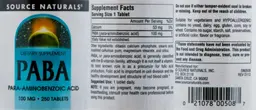
Label for PABA 100 mg
Open Full PDF View on NIH DSLD →
Details

Label Data

1 Tablet(s)
Serving Size
250
Servings
Non-Nutrient/Non-Botanical
Product Type
0%
Evidence Coverage
Ingredients

Supplement Facts — Evidence Check

Calcium
53 mg (5% DV)
Market median: 500.0mg (9 products) 7 studies — no high-quality reviews

Other Ingredients

Dibasic Calcium Phosphate Stearic Acid modified Cellulose Gum Magnesium Stearate Silica
Claims

Label Claims — Verification

Unverified All Other
Unverified Structure/Function
Info

Product Information

Directions for Use

Suggested Use: 1 tablet daily.

Warnings & Precautions

Note: If you are pregnant, may become pregnant, or breastfeeding, consult your health care professional before using this product.

Do not use if either tamper-evident seal is broken or missing.

Keep out of the reach of children.

Formulation Notes

Para-Aminobenzoic Acid PABA, or para-aminobenzoic acid, is generally classified with the B-vitamin family, although it is not itself a vitamin. Its best known role is a precursor for folic acid production. Folic acid is important in cell division and the healthy development and structure of red blood cells.

Suitable for vegetarians and Hypoallergenic: Contains no yeast, dairy, egg, gluten, corn, soy or wheat.

Suitable for vegetarians and Hypoallergenic: Contains no yeast, dairy, egg, gluten, corn, soy or wheat.

Suitable for vegetarians and Hypoallergenic: Contains no yeast, dairy, egg, gluten, corn, soy or wheat. Contains no sugar, starch, salt, preservatives, or artificial color, flavor or fragrance.

Metadata

Product Details

UPC / SKU0 21078 00508 7
DSLD Entry Date2023-08-23
Product TypeNon-Nutrient/Non-Botanical
FormTablet or Pill
DSLD ID296120
Data Updated2026-04-11
Research

Research Evidence

7
Research Sources
26
Avg Quality
5
Other
2
Rct
C Para-aminobenzoic acid (PABA) used as a marker for completeness of 24 hour urine: effects of age and dosage scheduling
Rct European journal of clinical nutrition 2003 PubMed
D [The diagnostic value of serum PABA determination in pancreatic disease and in relation to anticholinergic medication]
Rct Gastroenterologisches Journal : Organ der Gesellschaft fur Gastroenterologie der DDR 1989 PubMed
D Para-aminobenzoic acid therapy in scleroderma and lymphoblastoma cutis
Other The Journal of laboratory and clinical medicine 1948 PubMed
F The PABA story
Other The Australasian journal of dermatology 1999 PubMed
F Sodium para-aminobenzoate PABA in the treatment of dermatoses
Other The Journal of investigative dermatology 1952 PubMed
F Para-aminobenzoic acid therapy in lymphoblastoma cutis and mycosis fungoides
Other Cancer 1954 PubMed
F Photochemical formation of singlet molecular oxygen (1O2) in illuminated aqueous solutions of p-aminobenzoic acid (PABA)
Other Journal of photochemistry and photobiology. B, Biology 1996 PubMed
View all evidence for Paba →
Compare

Similar Products

View all Paba products →

This product page is for informational purposes only and does not constitute medical advice. Always consult your healthcare provider before taking any supplement.