🟢 100/100

This product looks safe

  • No ingredients exceed tolerable upper intake levels
  • 100% of ingredients have research evidence
A Label Compliance Grade

Product Label

📸

Have a supplement label? Find it here.

Upload a photo of any supplement label to search our database of 92,312 products.

Label Data

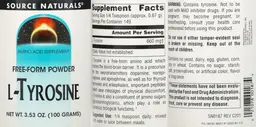
0.67 Gram(s) Serving Size
149 Servings
Amino acid/Protein Product Type
100% Evidence Coverage

Supplement Facts — Evidence Check

660 mg
📊 Market median: 500.0mg (223 products) 📚 22 studies (Tier A: 0, B: 1)
This product: 660mg

Label Claims — Verification

Nutrient
All Other
Structure/Function
All Other (98% of products) Structure/Function (78% of products) Nutrient (56% of products)

Target Groups

Adult (18 - 50 Years) Gluten Free Dairy Free Sugar Free

Product Information

📋 Directions for Use

Suggested Use: 1/4 teaspoon daily, mixed with water or juice between meals.

⚠️ Warnings & Precautions

Not to be used with MAO inhibitor drugs. If you are pregnant, may become pregnant, or breastfeeding, consult your health care professional before using this product.

Do not use if either tamper-evident seal is broken or missing.

Keep out of the reach of children.

Warning: Contains tyrosine.

🧪 Formulation Notes

Free-form powder

L-Tyrosine is a free-form amino acid which crosses the blood-brain barrier. It is a precursor for the neurotransmitters dopamine, norepinephrine, and epinephrine, as well as for thyroid hormones and enkephalins, important peptides which ease messages of physical discomfort. L-Tyrosine is also a constituent of amino sugars (glycosaminoglycans), which play a role in numerous biological functions.

Contains no yeast, dairy, egg, gluten, corn, soy or wheat. Contains no sugar, starch, salt, preservatives, or artificial color, flavor or fragrance.

Product Details

UPC / SKU 0 21078 00187 4
DSLD Entry Date 2022-11-22
Product Type Amino acid/Protein
Form Powder
DSLD ID 274814
Data Updated 2026-04-11

Research Evidence

50 Research Sources
47 Avg Quality Score
28 Rct
13 Clinical Trial
5 Guideline
4 Systematic Review
A Using a Novel Consensus-Based Chemoinformatics Approach to Predict ADMET Properties and Druglikeness of Tyrosine Kinase Inhibitors.
Guideline International journal of molecular sciences 2025
B Australia and New Zealand consensus statement on the cardiovascular management of patients with chronic lymphocytic leukaemia treated with Bruton's tyrosine kinase inhibitors.
Guideline Internal medicine journal 2025
B Branched-chain amino acid supplementation for improving growth and development in term and preterm neonates
Systematic Review The Cochrane database of systematic reviews 2020
B [Clinical practice guideline on anaplastic lymphoma kinase-tyrosine kinase inhibitors for non-small cell lung cancer (2025 edition)].
Guideline Zhonghua zhong liu za zhi [Chinese journal of oncology] 2025
B [Chinese expert consensus on epidermal growth factor receptor tyrosine kinase inhibitors for the treatment of non-small cell lung cancer (2025 edition)].
Guideline Zhonghua yi xue za zhi 2025
B Consensus Guideline for the Diagnosis and Treatment of Tyrosine Hydroxylase (TH) Deficiency.
Guideline Journal of inherited metabolic disease 2025
B Baseline-dependent effect of dopamine's precursor L-tyrosine on working memory gating but not updating
Rct Cognitive, affective & behavioral neuroscience 2020
B Effect of Amino Acid Supplementation on Iron Regulation after Endurance Exercise
Rct Nutrients 2023
C Attenuating Muscle Damage Biomarkers and Muscle Soreness After an Exercise-Induced Muscle Damage with Branched-Chain Amino Acid (BCAA) Supplementation: A Systematic Review and Meta-analysis with Meta-regression
Systematic Review Sports medicine - open 2024
C The Effects of Green Tea Amino Acid L-Theanine Consumption on the Ability to Manage Stress and Anxiety Levels: a Systematic Review
Systematic Review Plant foods for human nutrition (Dordrecht, Netherlands) 2020
View all evidence for Tyrosine →

Compare Similar Products

View all Tyrosine products →